Top 7 AWS Storage Classes for Cost Efficiency
Compare seven S3 storage classes by cost, retrieval time and minimum duration to pick the most cost‑effective option.

AWS offers seven storage classes for Amazon S3, each designed to balance cost and performance based on your data's access patterns. Choosing cost-effective AWS services can help you save between 40% and 95% on storage costs without compromising data durability (11 nines). Here’s a quick breakdown:
- S3 Standard: Best for frequently accessed data; costs ~£0.018/GB/month.
- S3 Intelligent-Tiering: Automatically adjusts tiers for unpredictable access; includes a monitoring fee (~£0.002/1,000 objects).
- S3 Standard-IA: Ideal for data accessed less than once a month; storage costs ~£0.010/GB/month but includes retrieval fees.
- S3 One Zone-IA: Lower-cost option (~£0.008/GB/month) for recreatable data stored in a single Availability Zone.
- S3 Glacier Instant Retrieval: For archives needing instant access; costs ~£0.003/GB/month with retrieval fees.
- S3 Glacier Flexible Retrieval: Suitable for rarely accessed archives; retrieval takes hours but costs ~£0.003/GB/month.
- S3 Glacier Deep Archive: Best for long-term, rarely accessed data; costs ~£0.00078/GB/month with retrieval times of 12–48 hours.
Quick Tip: Use S3 Lifecycle Policies to automate transitions between classes and optimise costs further with these AWS cost optimization tips. For unpredictable access, S3 Intelligent-Tiering is a great option, while Glacier tiers are best for long-term archives.
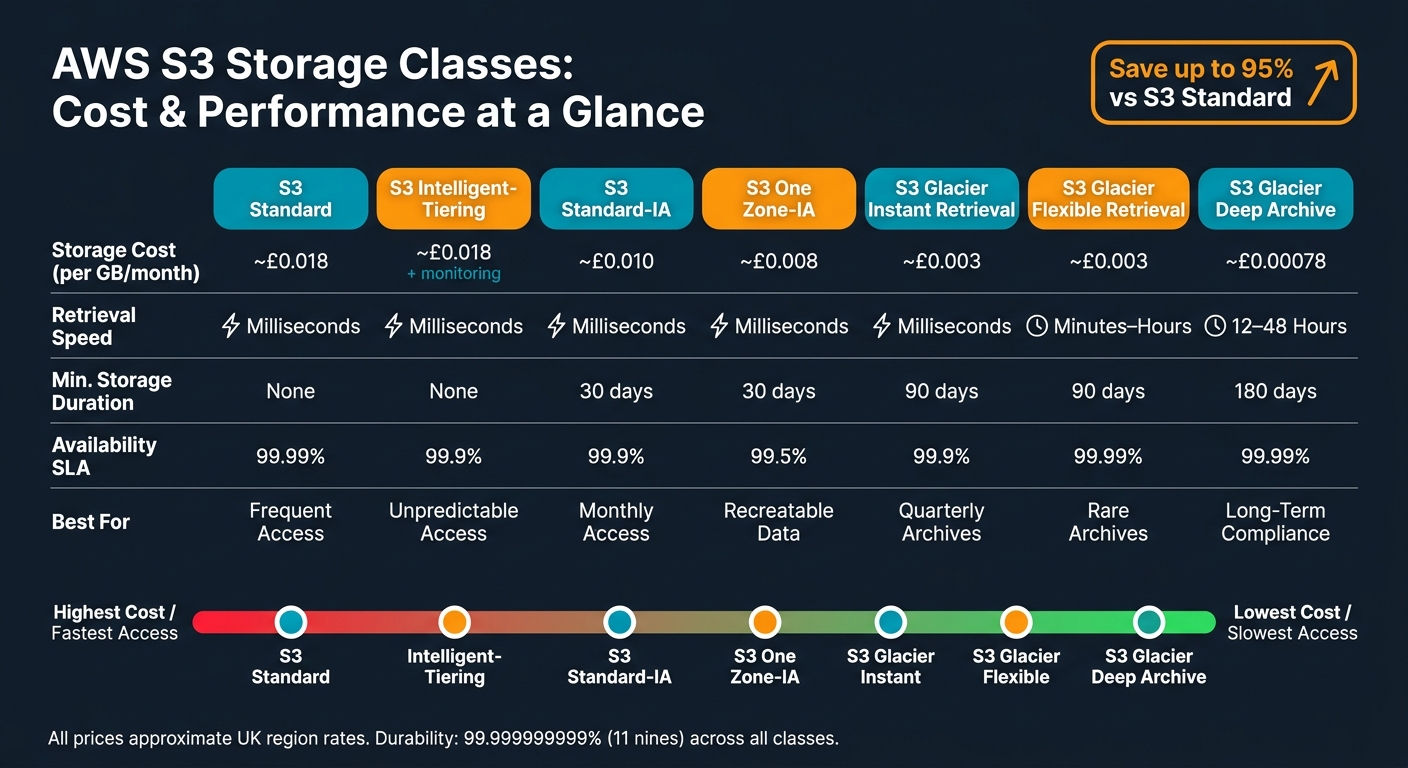
AWS S3 Storage Classes: Cost & Performance Comparison
AWS S3 Storage Classes Explained (Beginner’s Guide 2025) | AWS Zero to Hero Day 19
sbb-itb-0f2792e
Quick Comparison
| Storage Class | Best For | Storage Cost (per GB/month) | Retrieval Time | Min. Storage Duration | Availability SLA |
|---|---|---|---|---|---|
| S3 Standard | Frequently accessed data | ~£0.018 | Milliseconds | None | 99.99% |
| S3 Intelligent-Tiering | Unpredictable access patterns | ~£0.018 + monitoring fee | Milliseconds | None | 99.9% |
| S3 Standard-IA | Infrequent access (monthly) | ~£0.010 | Milliseconds | 30 days | 99.9% |
| S3 One Zone-IA | Recreatable, infrequent data | ~£0.008 | Milliseconds | 30 days | 99.5% |
| S3 Glacier Instant Retrieval | Archives needing instant access | ~£0.003 | Milliseconds | 90 days | 99.9% |
| S3 Glacier Flexible Retrieval | Occasional archive access | ~£0.003 | Minutes to hours | 90 days | 99.99% |
| S3 Glacier Deep Archive | Long-term compliance archives | ~£0.00078 | 12–48 hours | 180 days | 99.99% |
How AWS Storage Classes Affect Data Lifecycle Cost
AWS storage classes come with a mix of storage fees, retrieval charges, and minimum duration commitments. Knowing how these elements interact is crucial to keeping costs under control and avoiding unexpected expenses. Let’s break it down with some examples.
Storage fees drop significantly as data access frequency decreases. For instance, S3 Standard costs about £0.018 per GB per month, whereas S3 Glacier Deep Archive is priced at roughly £0.00079 per GB per month. That’s a staggering 23-fold difference for storing the same amount of data. However, lower-cost classes often involve retrieval fees. For example, S3 Standard-Infrequent Access (Standard-IA) charges approximately £0.008 per GB when data is retrieved. If you frequently access that data, these retrieval fees can quickly outweigh the savings on storage.
Minimum storage duration policies can also impact your overall costs. Take S3 Glacier Deep Archive as an example: if you delete an object after 30 days, you’ll still be billed for a minimum of 180 days. Similarly, objects smaller than 128 KB in Standard-IA or Glacier Instant Retrieval are charged as if they occupy 128 KB. These rules can lead to unanticipated charges if not carefully considered.
Each storage class aligns with specific data access patterns. For daily-access data (hot data), S3 Standard is ideal. Monthly-access data (warm data) fits better with Standard-IA or One Zone-IA. Data accessed quarterly (cold data) works well with Glacier Instant Retrieval, while rarely accessed archival data is best suited for Glacier Flexible Retrieval or Glacier Deep Archive. For situations where access patterns are unpredictable, S3 Intelligent-Tiering automatically moves objects between tiers and charges a monitoring fee of about £0.002 per 1,000 objects.
"We are saving 37% annually in storage costs by using Amazon S3 Intelligent-Tiering to automatically move objects that have not been touched within 30 days to the infrequent-access tier." - Max Schultze, Lead Data Engineer, Zalando
Using S3 Lifecycle rules is another effective way to automate cost management. For instance, you could set up a rule to move server logs to Standard-IA after 30 days and then to Glacier after 90 days. Additionally, enabling the AbortIncompleteMultipartUpload rule can help remove partial uploads, which might otherwise rack up unnecessary charges over time. While Lifecycle rules are most effective when access patterns are predictable, Intelligent-Tiering offers a safer option for handling uncertain usage patterns.
1. S3 Intelligent-Tiering
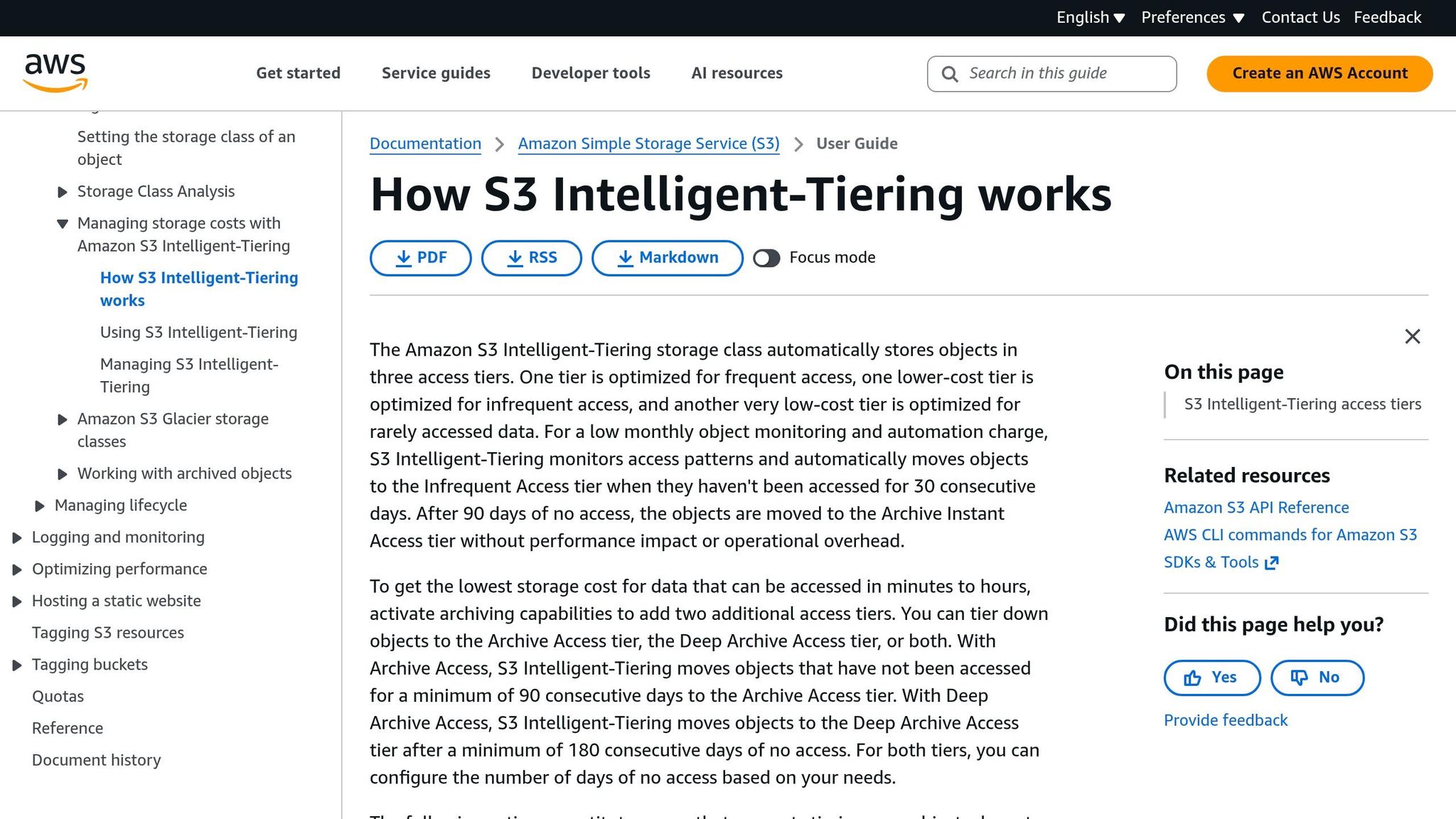
S3 Intelligent-Tiering is Amazon Web Services' automated storage solution designed for data with unpredictable access patterns. It's particularly useful for applications, data lakes, or workloads where it's hard to predict how often data will be accessed. Instead of requiring manual intervention, AWS automatically monitors each object and shifts it between tiers based on its actual usage.
Typical Access Pattern
This storage class works best for data with changing access patterns, removing the need to manually manage data lifecycles.
Storage Cost Levels
S3 Intelligent-Tiering offers five tiers, each with progressively lower storage costs for data that remains unaccessed over time:
| Access Tier | Movement Trigger | Storage Savings vs. Frequent | Retrieval Latency |
|---|---|---|---|
| Frequent Access | Default / upon access | 0% | Milliseconds |
| Infrequent Access | No access for 30 days | ~40% | Milliseconds |
| Archive Instant Access | No access for 90 days | ~68% | Milliseconds |
| Archive Access (opt-in) | No access for 90+ days | ~71% | 3–5 hours |
| Deep Archive Access (opt-in) | No access for 180+ days | ~95% | 12 hours |
While the system is efficient, there is a monitoring fee of approximately £0.002 per 1,000 objects for files larger than 128 KB. This means that buckets with numerous small files may not achieve the same cost savings. It's worth evaluating object sizes carefully to avoid unnecessary fees.
Since its introduction in 2018, S3 Intelligent-Tiering has reportedly saved AWS users over $6 billion (£4.7 billion) in storage costs compared to S3 Standard.
Retrieval Time
Frequent, Infrequent, and Archive Instant Access tiers all offer millisecond retrieval times. A standout feature of Intelligent-Tiering is that any object accessed in these tiers is automatically moved back to the Frequent Access tier at no extra cost. However, for data stored in the optional Archive Access and Deep Archive Access tiers, a restore request is required before the data can be read. This process takes 3–5 hours for Archive Access and up to 12 hours for Deep Archive Access.
Resilience Model
Data stored in S3 Intelligent-Tiering is replicated across at least three Availability Zones, ensuring durability of 99.999999999% (11 nines) and availability of 99.9%. This high level of reliability means you don't have to trade durability for cost savings.
"The S3 Intelligent-Tiering storage class delivered automatic storage savings based on the changing access patterns of our data without impact on performance." - Jerzy Grzywinski, Director of Software Engineering, Capital One
By aligning storage costs with how data is actually used, S3 Intelligent-Tiering demonstrates effective cost management for small and medium-sized businesses.
Minimum Storage Duration
One of the key benefits of S3 Intelligent-Tiering is its flexibility. Unlike Standard-IA or Glacier, there’s no minimum storage duration. If you delete an object early, you won’t be charged for a minimum period. This makes it an excellent choice for optimising data lifecycle costs while exploring other AWS storage options.
2. S3 Standard
S3 Standard is the default storage class for Amazon S3. If you upload an object without specifying a storage class, it automatically falls into this category. Unlike S3 Intelligent-Tiering, which adjusts storage tiers based on access patterns, S3 Standard is tailored for consistently high access frequencies.
Typical Access Pattern
This class is built for data that is accessed frequently - typically, more than once a month. It’s a great fit for hosting website assets like images, CSS, and JavaScript files, delivering mobile app content, supporting active databases, or powering real-time analytics. Essentially, it’s ideal for use cases involving constant read/write operations. These frequent access needs directly influence its pricing structure.
Storage Cost Level
S3 Standard has one of the highest storage costs among AWS S3 classes, with pricing at roughly £0.023 per GB per month, according to AWS rates. However, it does not charge for data retrieval. If your data is accessed more than about 1.05 times per month per GB, S3 Standard often works out to be more economical than S3 Standard-Infrequent Access. That said, write-heavy workloads can lead to higher costs due to the charges for PUT/POST requests.
"With S3, we were able to reduce storage costs by over 40%." - Sysco
Retrieval Time
One of the standout features of S3 Standard is its on-demand, millisecond-level access. There’s no waiting period, making it a top choice for applications where performance is critical.
Resilience Model
S3 Standard employs multi-AZ replication to ensure durability and availability. It is designed with a 99.99% availability rate, which translates to approximately 52.6 minutes of potential downtime annually.
Minimum Storage Duration
There’s no minimum storage duration or billable object size for S3 Standard. You only pay for the actual storage time, making it a flexible option for workloads that are short-lived or unpredictable.
3. S3 Standard-Infrequent Access
S3 Standard-Infrequent Access (S3 Standard-IA) is a cost-effective storage option designed for data that’s accessed less than once a month. For UK-based SMEs comparing AWS storage options to reduce expenses, this tier offers a practical balance between cost and accessibility, ensuring immediate access when needed.
Typical Access Pattern
S3 Standard-IA is ideal for data you don’t need to access regularly but still want readily available. Examples include backups, disaster recovery files, compliance records, and older application data. As AWS explains:
"S3 Standard-IA is ideal for long-lived data accessed less than once a month but requires immediate access when requested." - AWS
Storage Cost Level
The pricing for S3 Standard-IA is £0.010 per GB per month (around $0.0125), making it approximately 46% cheaper than S3 Standard when it comes to storage costs alone. However, there’s a retrieval fee of about $0.01 per GB whenever you access the data. This means the savings are significant if your data remains untouched for long periods. But frequent access could quickly offset those savings due to retrieval charges.
Retrieval Time and Resilience
When you do need your data, S3 Standard-IA delivers millisecond-level access without any delays. It also ensures high durability and availability, with 99.999999999% durability (eleven nines) and 99.9% availability, thanks to replication across multiple Availability Zones. This makes it a dependable choice for critical data that doesn’t require daily interaction.
Minimum Storage Duration
One key consideration is the 30-day minimum storage duration. If you delete or transition an object before 30 days are up, you’ll still be billed for the entire period. For data that’s frequently updated, S3 Standard may be a better fit. But for stable, rarely accessed data, S3 Standard-IA helps lower costs without compromising on availability or speed.
Next up, we’ll dive into Glacier options for even more affordable archival storage with longer retrieval times.
4. S3 One Zone-Infrequent Access
S3 One Zone-Infrequent Access (One Zone-IA) takes the concept of infrequent access a step further by storing data in a single Availability Zone. This choice reduces costs but comes with lower resilience, making it suitable only for data that can be easily recreated.
Typical Access Pattern
One Zone-IA is perfect for data you rarely need to access and can easily regenerate. Examples include secondary backups, auto-generated image thumbnails, transcoded media files, or copies used in cross-region replication. However, it’s not the right option for original or irreplaceable data, which is better suited to S3 Standard-IA.
"S3 One Zone-IA is ideal for recreatable data that doesn't require the resilience of multi-AZ storage." - AWS
Storage Cost Level
With a cost of approximately £0.008 per GB per month, One Zone-IA is about 20% cheaper than S3 Standard-IA. These savings grow significantly for businesses storing large amounts of secondary or regenerable data. However, the cost advantage only makes sense if the data can genuinely be recreated without issue.
Retrieval Time
Just like S3 Standard-IA, One Zone-IA offers millisecond retrieval. There’s no delay or waiting period, so your data is instantly accessible whenever needed.
Resilience Model
The major difference lies in resilience. Since data is stored in a single Availability Zone, a failure in that zone could result in data loss. While One Zone-IA maintains 99.999999999% durability under normal conditions, its availability SLA is 99.5%, compared to 99.9% for S3 Standard-IA. For non-critical, easily replaceable data, this trade-off is acceptable. For anything irreplaceable, it’s not worth the risk.
Minimum Storage Duration
Like S3 Standard-IA, One Zone-IA has a 30-day minimum storage duration. If you delete or transition an object before this period ends, you’ll still be billed for the full 30 days. To avoid unnecessary charges, use lifecycle policies to manage object transitions effectively and keep storage costs under control.
5. S3 Glacier Instant Retrieval
S3 Glacier Instant Retrieval is an entry-level archival storage class that offers instant access to data. It stands apart from the deeper Glacier tiers, making it an appealing choice for UK small and medium-sized businesses (SMBs) looking to manage their AWS storage costs effectively.
Typical Access Pattern
This storage class is tailored for data that's accessed infrequently but needs to be available immediately. AWS suggests it for data accessed roughly once per quarter. It's ideal for performance-sensitive archives, such as medical imaging records, media assets, and extensive collections of user-generated content.
Snap Inc., for example, transitioned 2 exabytes of data to S3 Glacier Instant Retrieval and saw substantial storage cost reductions while maintaining immediate access. As Vijay Manoharan, Manager of the Media-Delivery Platform Team at Snap Inc., explained:
"The fact that no customer noticed this major migration to Amazon S3 Glacier Instant Retrieval was a big win for us." - Vijay Manoharan, Snap Inc.
Storage Cost Level
The cost savings with this storage class are notable. At around £0.003 per GB per month, it offers approximately 68% savings compared to S3 Standard-IA for data accessed quarterly. However, retrieval fees are higher, at roughly £0.023 per GB retrieved, making it most beneficial for businesses that access data infrequently. If data retrieval exceeds once per quarter, those savings can diminish quickly due to escalating retrieval costs.
Retrieval Time
Accessing data is lightning-fast, with retrieval times measured in milliseconds. This matches the performance of S3 Standard and Standard-IA.
"S3 Glacier Instant Retrieval delivers the fastest access to archive storage, with the same throughput and milliseconds access as the S3 Standard and S3 Standard-IA storage classes." - Amazon Web Services
Resilience Model
Data stored in S3 Glacier Instant Retrieval is replicated across multiple Availability Zones, ensuring 99.999999999% (11 nines) durability and 99.9% availability. Unlike S3 One Zone-IA, it eliminates the risk of a single point of failure, making it a dependable choice for data that cannot be compromised.
Minimum Storage Duration
The minimum storage duration is 90 days, and objects are billed for the entire period if they are deleted or transitioned earlier. To maximise cost efficiency, carefully use lifecycle policies to ensure data is moved to this class only when it transitions into a long-term, low-access phase. Up next, a summary table will compare these tiers to help you decide which option fits your data lifecycle best.
6. S3 Glacier Flexible Retrieval
S3 Glacier Flexible Retrieval builds on the capabilities of Glacier Instant Retrieval but is tailored for data accessed even less frequently. It trades faster access times for lower costs, making it a great fit for scenarios where data retrieval can take hours.
Typical Access Pattern
This storage option is perfect for data that's rarely accessed - perhaps only once or twice a year. It's commonly used for long-term archiving needs like AWS backup solutions, disaster recovery, compliance documentation, or historical records. For instance, in March 2023, Sysco shared that they reduced their storage costs by over 40% by moving data to S3 Glacier. The infrequent nature of access in these cases helps keep expenses low.
Storage Cost Level
With a storage cost of approximately £0.003 per GB per month, S3 Glacier Flexible Retrieval is a cost-effective choice. Retrieval fees range between £0.008 and £0.024 per GB. For businesses handling large-scale data, bulk retrievals are especially appealing since they come at no additional cost. This makes it a practical solution for smaller companies working with tight budgets.
Retrieval Time
The retrieval time depends on the option chosen, as shown below:
| Retrieval Option | Typical Time | Cost |
|---|---|---|
| Expedited | 1–5 minutes | Higher cost per GB |
| Standard | 3–5 hours | Mid-range cost per GB |
| Bulk | 5–12 hours | Free |
"S3 Glacier Flexible Retrieval delivers the most flexible retrieval options that balance cost with access times ranging from minutes to hours." - Amazon Web Services
Minimum Storage Duration
This class requires a minimum storage duration of 90 days. If objects are deleted or transitioned before this period ends, charges for the full 90 days will still apply. To avoid unnecessary expenses, it's essential to carefully plan your lifecycle policies and align them with your data management strategy.
7. S3 Glacier Deep Archive
S3 Glacier Deep Archive is the most economical storage option in AWS's lineup. While S3 Glacier Flexible Retrieval works well for infrequently accessed data, Deep Archive is tailored for data you need to keep but almost never plan to retrieve.
Typical Access Pattern
If your priority is keeping costs as low as possible and immediate access isn't a concern, this class is ideal for data accessed less than once a year. It's perfect for compliance archives, legal holds, financial documents, and healthcare records that must be retained for 7–10 years. The trade-off? You get the lowest storage costs but with significantly slower retrieval times.
Storage Cost Level
With a cost of approximately £0.00078 per GB per month, S3 Glacier Deep Archive is about 23 times cheaper than S3 Standard. To put that into perspective, storing 100 TB would cost around £78 per month compared to £1,800, offering savings of roughly 96%.
"S3 Glacier Deep Archive is the lowest cost storage class designed for long-term retention of data that will be retained for 7–10 years." - Amazon Web Services
Retrieval Time
Retrieval times are deliberately slow, reflecting its focus on cost savings. Standard retrievals typically take 12 hours, while bulk retrievals can take up to 48 hours. Here's a quick breakdown:
| Retrieval Option | Typical Time |
|---|---|
| Standard | ~12 hours |
| Bulk | Up to 48 hours |
These delays are generally acceptable for data that is rarely accessed, given the substantial cost advantages.
Resilience Model
S3 Glacier Deep Archive ensures high durability by storing data across multiple Availability Zones, offering an impressive 11 nines of durability (99.999999999%). Even with its low price, this multi-AZ replication guarantees the reliability needed for compliance archives, making it a robust alternative to traditional on-premises tape storage.
Minimum Storage Duration
The minimum storage duration for this class is 180 days. If you delete or transition data before this period ends, you'll still be charged for the full 180 days. However, given its focus on long-term retention, this is rarely an issue. For organisations looking to maximise cost efficiency for non-urgent, long-term archives, S3 Glacier Deep Archive is an excellent choice.
Comparison Table
Here's a breakdown of the seven storage classes, highlighting their costs, access speeds, availability, and storage commitments. This table can serve as a handy reference when deciding which class fits your data needs.
| Storage Class | Best For | Storage Cost (per GB/month) | Retrieval Time | Min. Storage Duration | Availability SLA |
|---|---|---|---|---|---|
| S3 Standard | Frequently accessed data | ~£0.018 | Milliseconds | None | 99.99% |
| S3 Intelligent-Tiering | Unpredictable access patterns | ~£0.018 + monitoring fee | Milliseconds | None | 99.9% |
| S3 Standard-IA | Infrequent access (monthly) | ~£0.010 | Milliseconds | 30 days | 99.9% |
| S3 One Zone-IA | Recreatable, infrequent data | ~£0.008 | Milliseconds | 30 days | 99.5% |
| S3 Glacier Instant Retrieval | Archives needing instant access | ~£0.003 | Milliseconds | 90 days | 99.9% |
| S3 Glacier Flexible Retrieval | Occasional archive access | ~£0.003 | Minutes to hours | 90 days | 99.99% |
| S3 Glacier Deep Archive | Long-term compliance archives | ~£0.00078 | 12–48 hours | 180 days | 99.99% |
S3 Standard and S3 Intelligent-Tiering stand out for their flexibility, as they don't require a minimum storage duration. This makes them ideal for data with unpredictable lifespans. On the other hand, Glacier classes are more cost-effective but come with longer retrieval times and stricter storage commitments.
It's important to note that lower availability doesn't mean reduced durability. For instance, S3 One Zone-IA has a 99.5% availability SLA because it stores data in a single Availability Zone. However, it still offers 11 nines of durability, ensuring data safety. The trade-off here is with access reliability, not data integrity.
"Choosing the right class can reduce storage costs by 50–95% without sacrificing durability." - Inventive HQ Team, AWS S3 Storage Classes Guide
This table is a quick guide to help you align your storage choices with your data lifecycle strategy. For more detailed insights, revisit earlier sections to understand each class in depth.
Conclusion
Choosing the right AWS storage class for each stage of your data's lifecycle can significantly cut costs while maintaining data integrity. Incorporating these classes into your strategy enhances both performance and cost management. For example, S3 Standard is ideal for frequently accessed data, while S3 Intelligent-Tiering automatically adjusts to unpredictable access patterns. As data becomes less active, transitioning it through Standard-IA, One Zone-IA, and finally to the Glacier tiers can lead to substantial savings.
To put this into perspective, S3 Standard costs approximately £0.018 per GB per month, whereas S3 Glacier Deep Archive comes in at just £0.00078 per GB per month - a saving of over 95%. This cost difference is especially impactful when storing large volumes of compliance records, backups, or historical data. By understanding AWS storage classes, you can align your data management strategies with cost-saving opportunities throughout the data lifecycle.
Automating these transitions is straightforward with S3 Lifecycle Policies, and you can use S3 Storage Class Analysis to track access patterns and make informed decisions.
"Choosing the right storage class can reduce storage costs by 50–95% without sacrificing durability." - AWS Storage Blog
For UK small and medium-sized businesses looking to optimise AWS costs further, check out the AWS Optimization Tips, Costs & Best Practices for Small and Medium sized businesses blog by Critical Cloud for actionable advice.
FAQs
How do I choose the right S3 storage class for my access pattern?
To choose the best S3 storage class, consider how often you access your data, the speed you need for retrieval, and how predictable your access patterns are.
- S3 Standard is ideal for data you access frequently and need with millisecond latency.
- S3 Intelligent-Tiering is a cost-efficient choice for data with unpredictable access patterns, as it automatically adjusts storage costs based on usage.
- For data you access less often, S3 Standard-IA or One Zone-IA are better options.
- If you're storing archival data, the S3 Glacier classes offer a cost-effective solution. Choose between Instant Retrieval for millisecond access or Deep Archive for data that can wait hours to retrieve.
Each class is designed to balance cost and performance based on your specific needs.
When does S3 Intelligent-Tiering become more expensive than it saves?
S3 Intelligent-Tiering might not be the most cost-effective choice when you're dealing with millions of small objects. Why? The £0.0020 per 1,000 objects monthly monitoring fee can quickly add up, potentially negating any storage savings you might gain. Plus, objects smaller than 128KB are always billed at Frequent Access tier rates and won't benefit from automatic tiering.
For workloads that involve a large number of small files or have predictable access patterns, setting up manual lifecycle policies often proves to be a more budget-friendly approach.
How can I avoid minimum storage duration and retrieval fee surprises?
To keep costs in check, it's crucial to match your data's access patterns with the right Amazon S3 storage class. S3 Standard and S3 Intelligent-Tiering are excellent choices for data with active or unpredictable access needs. These classes come with no minimum storage duration or retrieval fees, making them flexible and cost-effective for such workloads.
For data accessed less frequently, options like S3 Standard-IA, Glacier Instant Retrieval, and Deep Archive provide lower storage rates. However, they come with minimum storage durations of 30, 90, and 180 days respectively. If you delete data before these periods are up, you'll face pro-rated charges. So, planning your usage carefully is key to avoiding unexpected expenses.